
7 Principles for Educating Kids in the Age of AI
7 Principles for Educating Kids in the Age of AI
By Doug MacDonald · · 12 min read
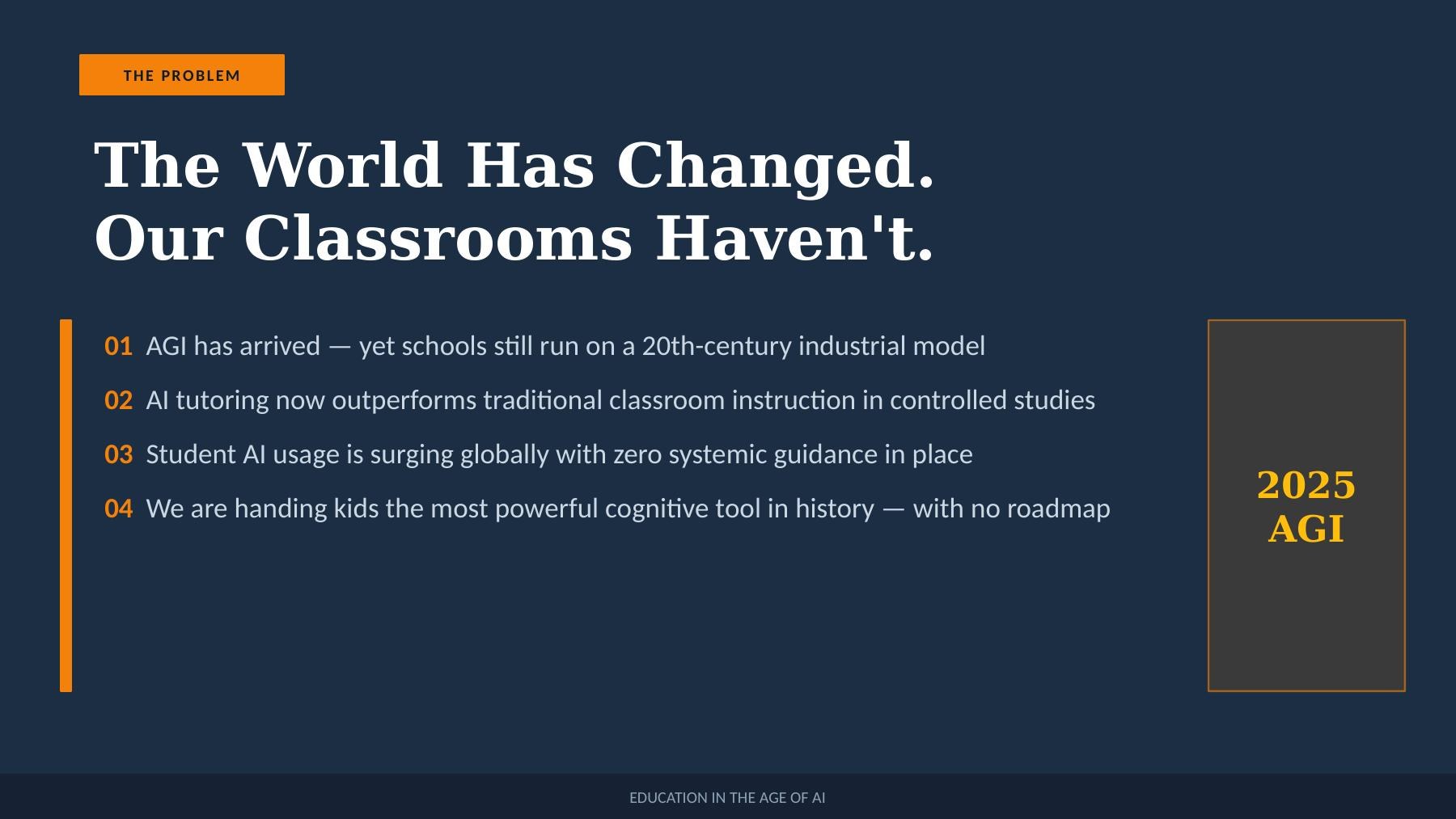
AI tutoring now outperforms traditional classroom instruction in controlled studies. Student AI usage is surging globally. And we have no systemic guidance in place for any of it.
That is not a technology problem. It is a sequencing problem. The question is not whether our kids will use AI — they already are. The question is whether we build the foundation before we hand them the power tool.
We’ve Been Here Before
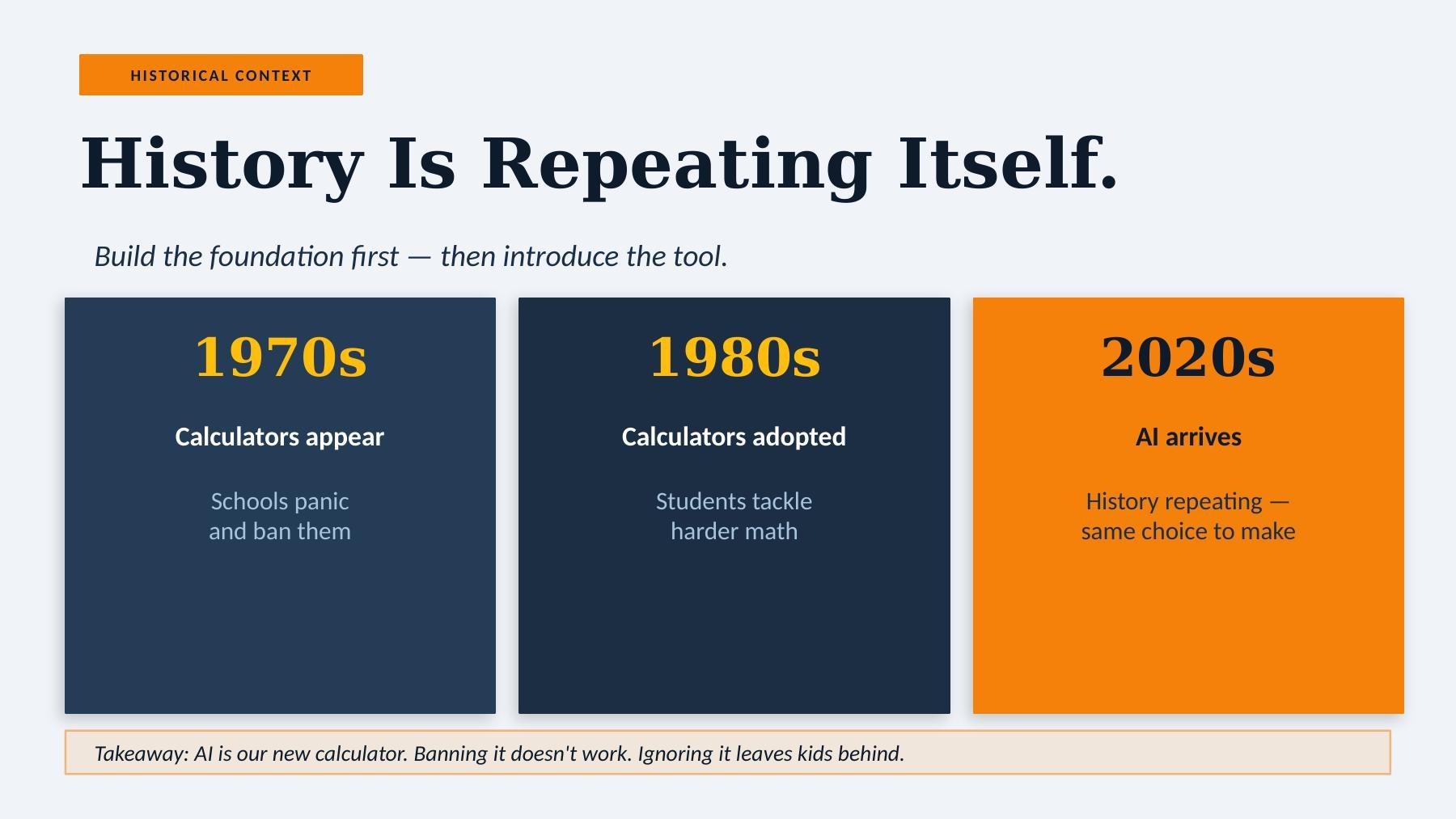
When pocket calculators arrived in the 1970s, schools panicked and banned them. By the 1980s, schools that embraced calculators thoughtfully found that students who understood arithmetic first could tackle harder math. The tool amplified capability — it didn’t replace it.
AI is our new calculator. Banning it doesn’t work. Ignoring it leaves kids behind. But unlike calculators, AI can fake thinking entirely — which changes the stakes and the sequencing dramatically.
The Silent Threat: Cognitive Offloading
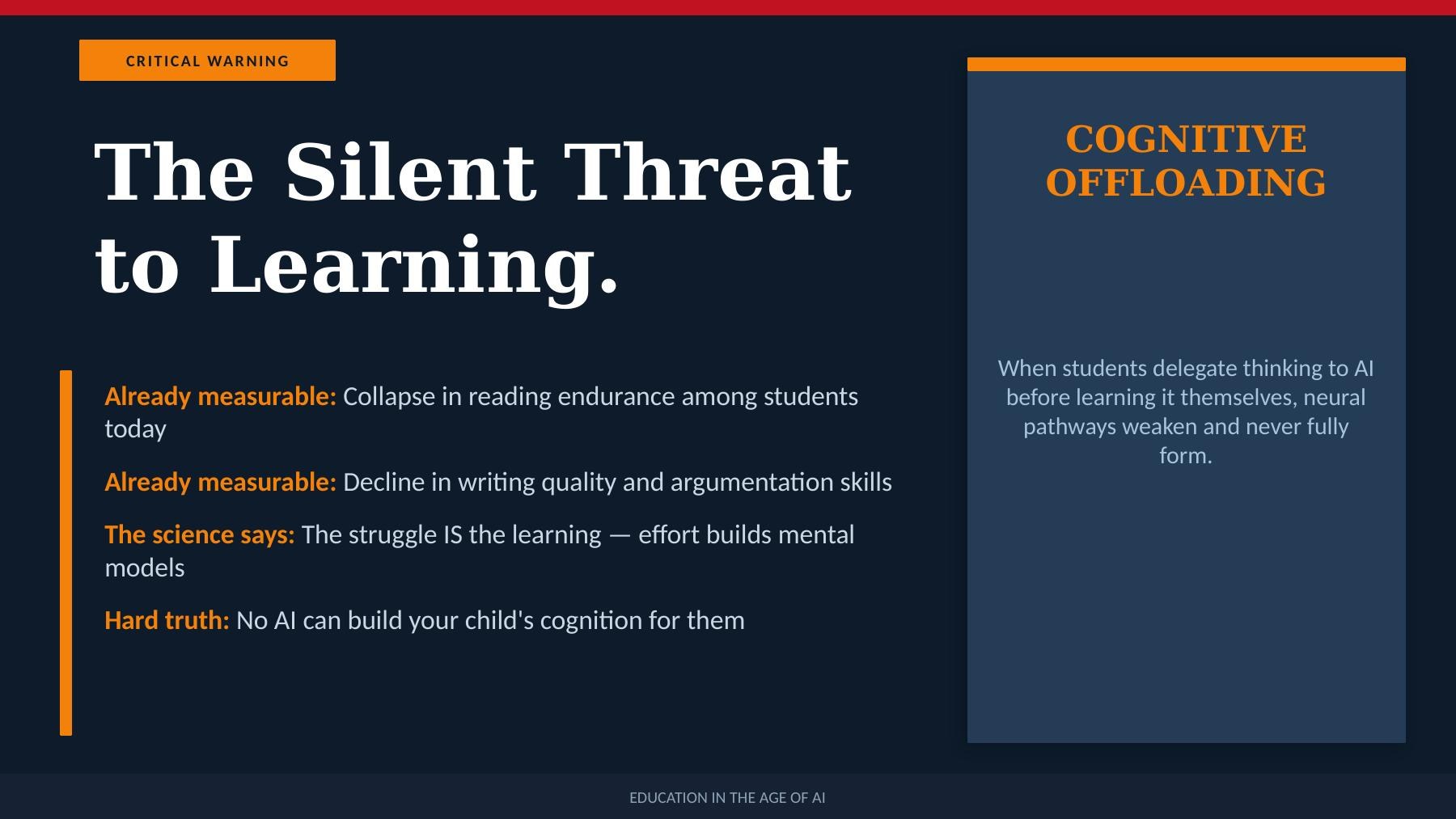
What the research shows:
- Measurable collapse in reading endurance among students today
- Decline in writing quality and argumentation skills
- Reduced ability to hold and develop complex thoughts independently
Cognitive offloading is when a student delegates a thinking task to AI before they’ve learned to do that task themselves. The problem is neuroscientific: the struggle of learning IS the learning. Effort builds the mental models and neural pathways that AI cannot build for you.
The Ultimate Future Skill: Metacognition
Metacognition has three components in the AI age: knowing what you know (so you can verify AI output), knowing what you don’t know (so you recognize dangerous blind spots), and deciding when to delegate (the judgment of when AI amplifies you vs. replaces you). Everything in the seven principles below builds these capacities.
The 7 Principles of Future-Proof Education
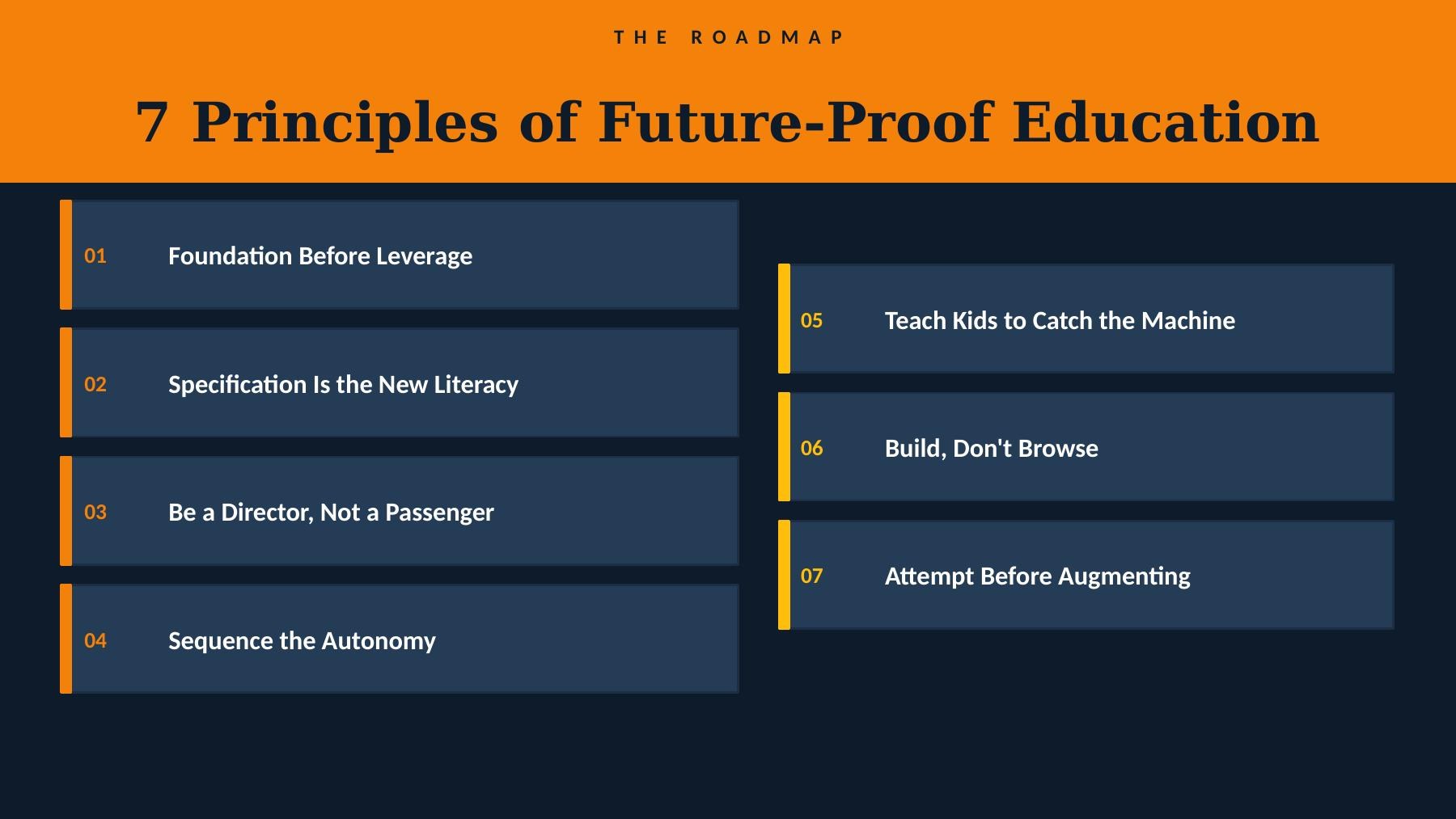
Quick Reference
- Foundation Before Leverage — Build the brain. Then give it an exoskeleton.
- Specification Is the New Literacy — The quality of AI output = the quality of human input.
- Be a Director, Not a Passenger — Active command vs. passive consumption.
- Sequence the Autonomy — Earn access through demonstrated readiness.
- Teach Kids to Catch the Machine — AI can be confidently, fluently wrong.
- Build, Don’t Browse — Creation compounds. Consumption evaporates.
- Attempt Before Augmenting — Your brain goes first. Always.
Foundation Before Leverage
Build the brain. Then give it an exoskeleton.
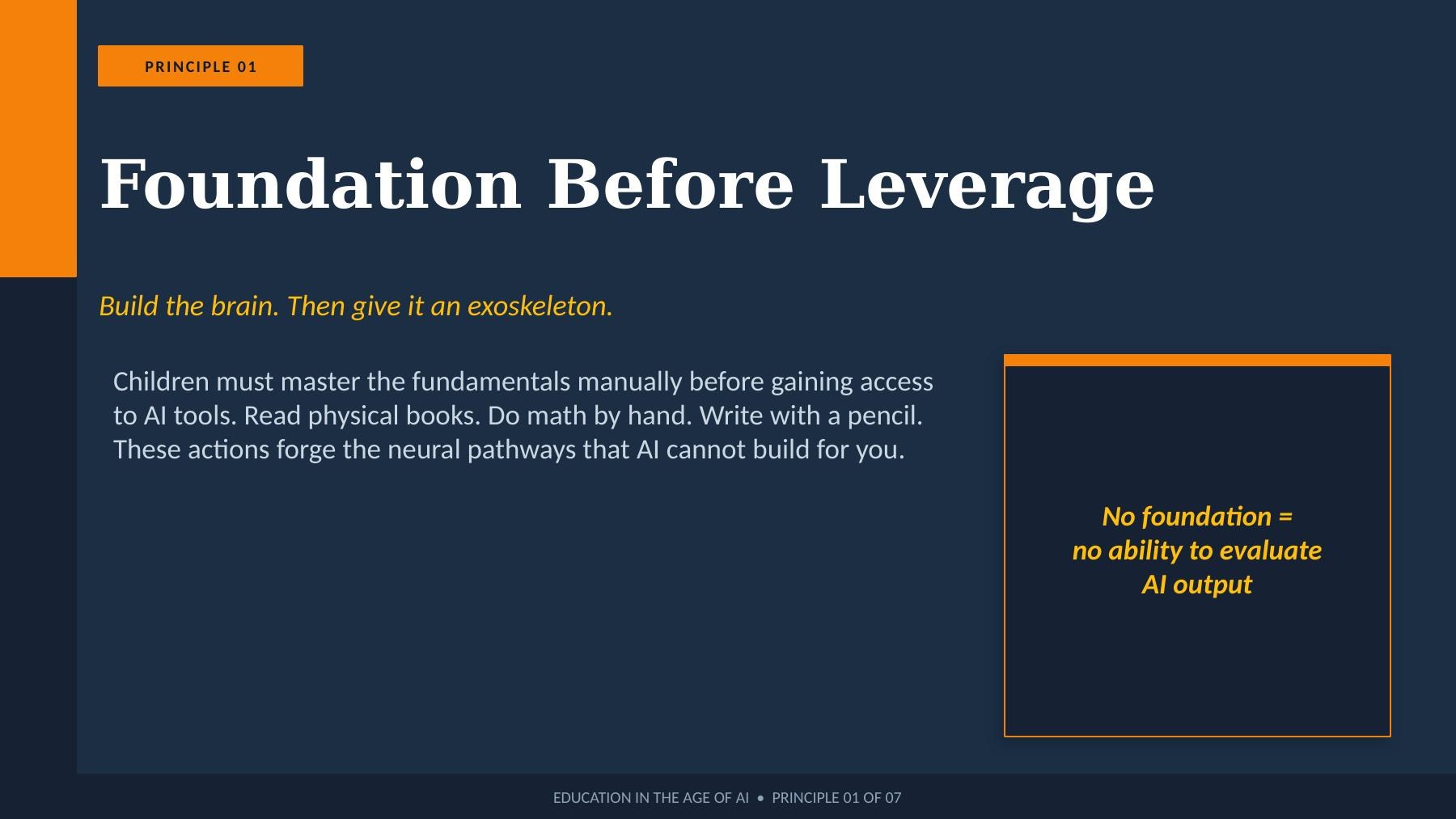
Children must master the fundamentals manually before gaining access to AI tools. Read physical books. Do math by hand. Write with a pencil. These actions forge the neural pathways that AI cannot build for you. The inefficiency of manual work is the point — the friction of retrieval and the effort of composition produce durable cognitive structure.
Specification Is the New Literacy
The quality of AI output = the quality of human input.
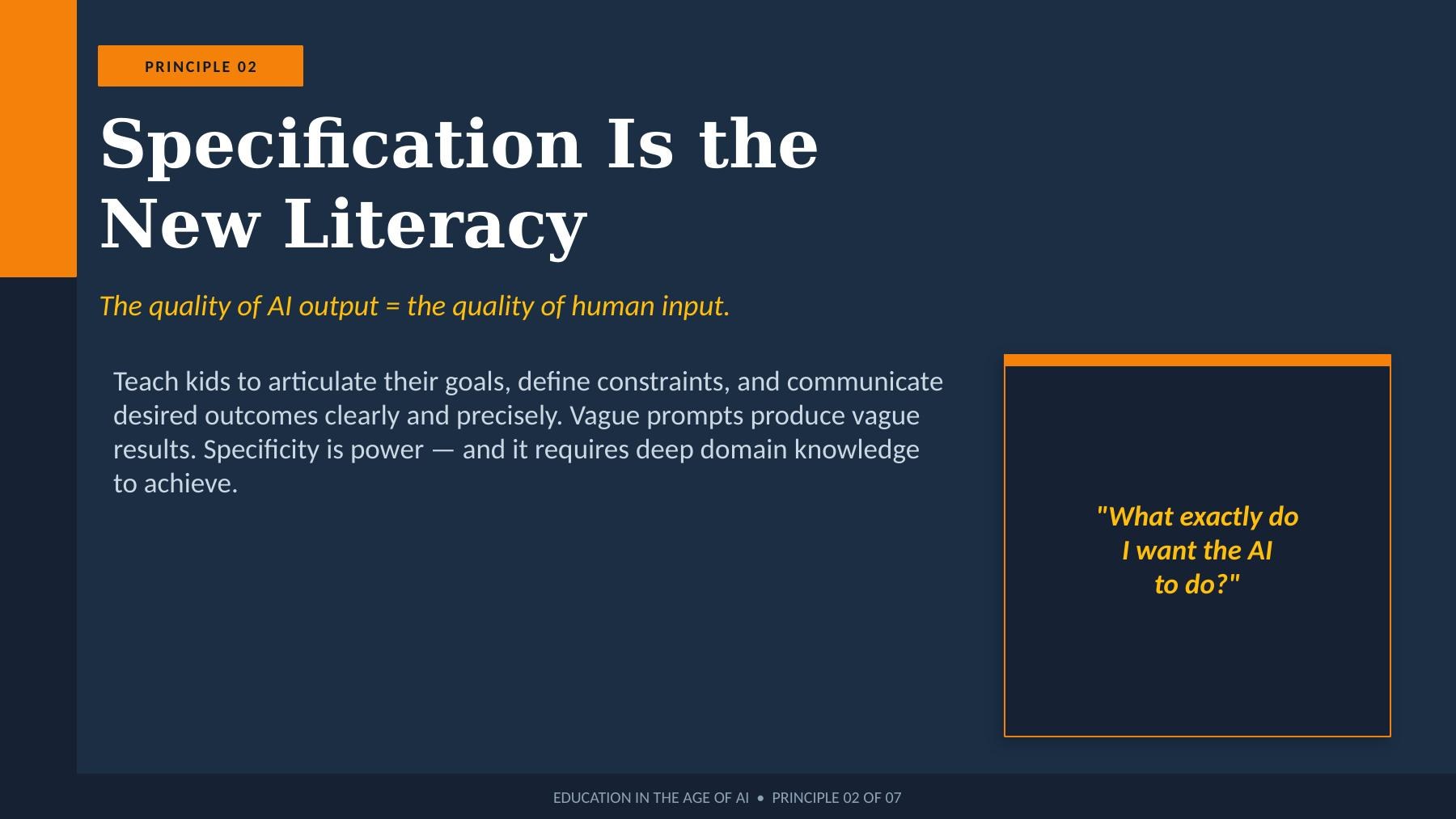
Specification — the ability to precisely articulate goals, constraints, and desired outcomes — is the literacy skill of the AI age. Teach kids to ask: “What exactly do I want the AI to do?” Vague prompts produce vague results. This skill requires deep domain knowledge to achieve, which is why principles 1 and 2 are inseparable.
Be a Director, Not a Passenger
Active command vs. passive consumption.
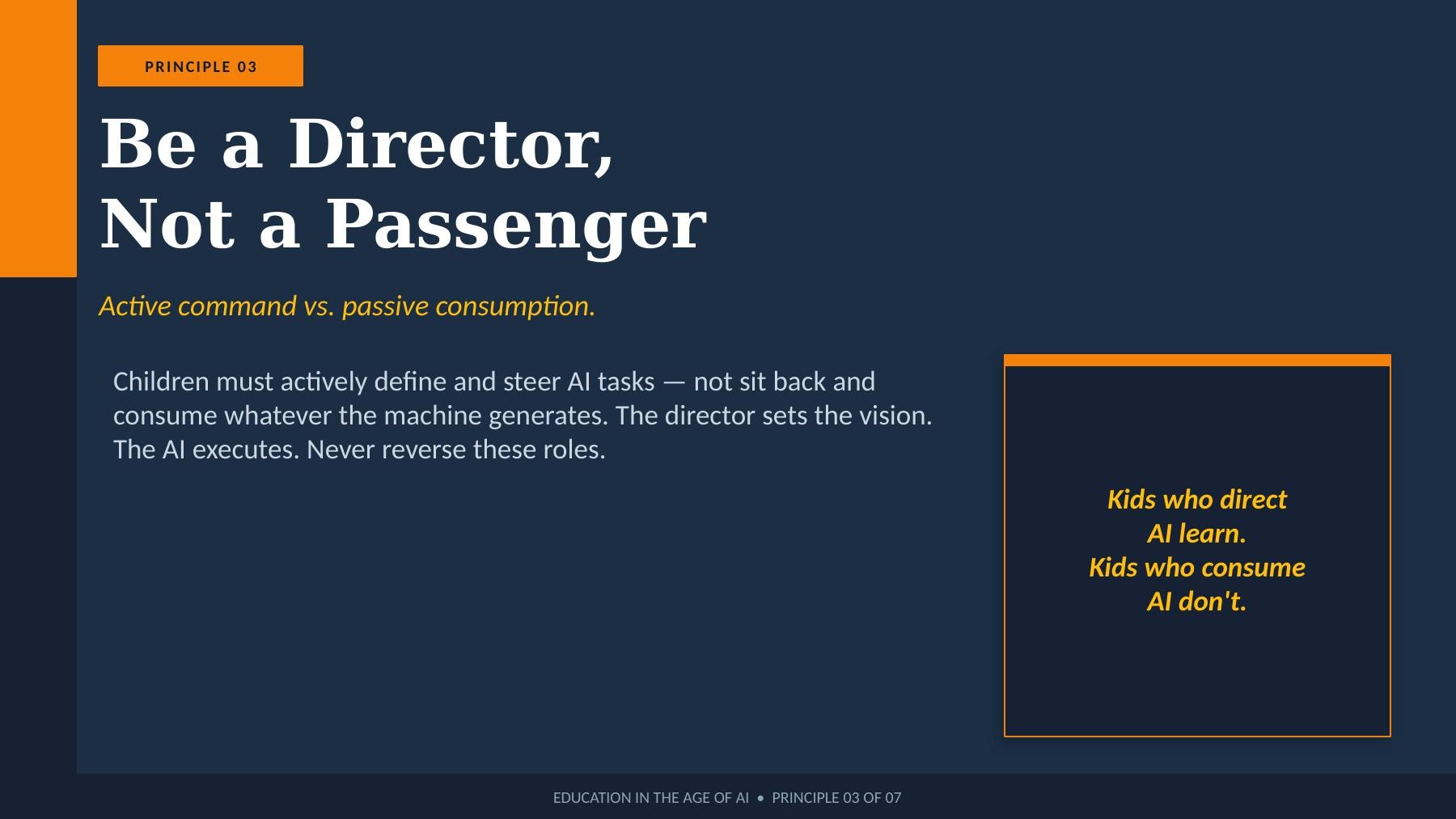
The director defines the goal, evaluates the output, pushes back, redirects, and iterates. The passenger accepts whatever the machine generates and calls it done. The director is learning. The passenger is not. Children must actively define and steer AI tasks — never reverse the roles.
Sequence the Autonomy
Earn access through demonstrated readiness.
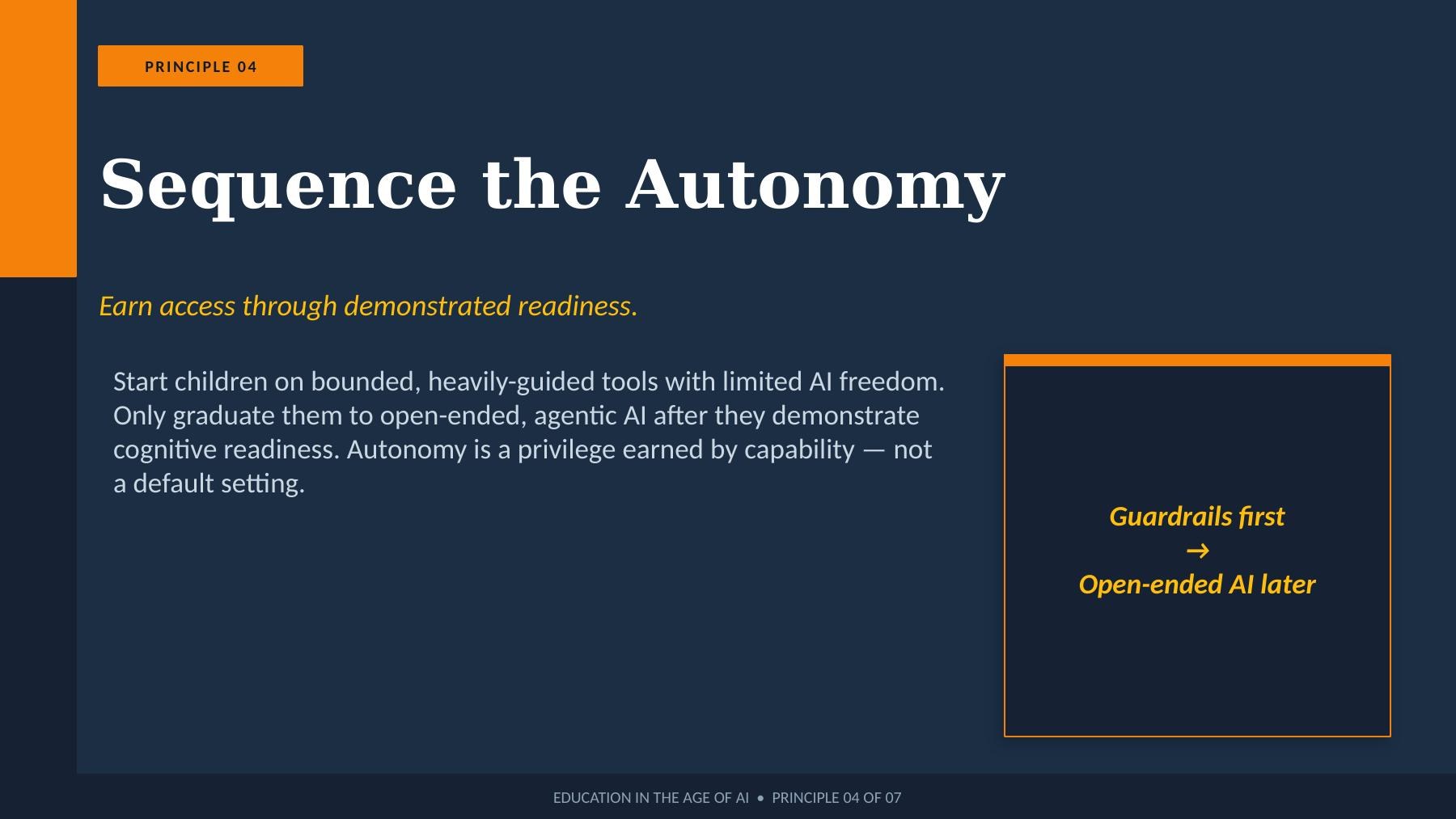
Start children on bounded, heavily-guided tools. Only graduate them to open-ended, agentic AI after they demonstrate cognitive readiness — the ability to evaluate output, catch errors, and direct the tool purposefully. Autonomy is a privilege earned by capability, not a default setting.
Teach Kids to Catch the Machine
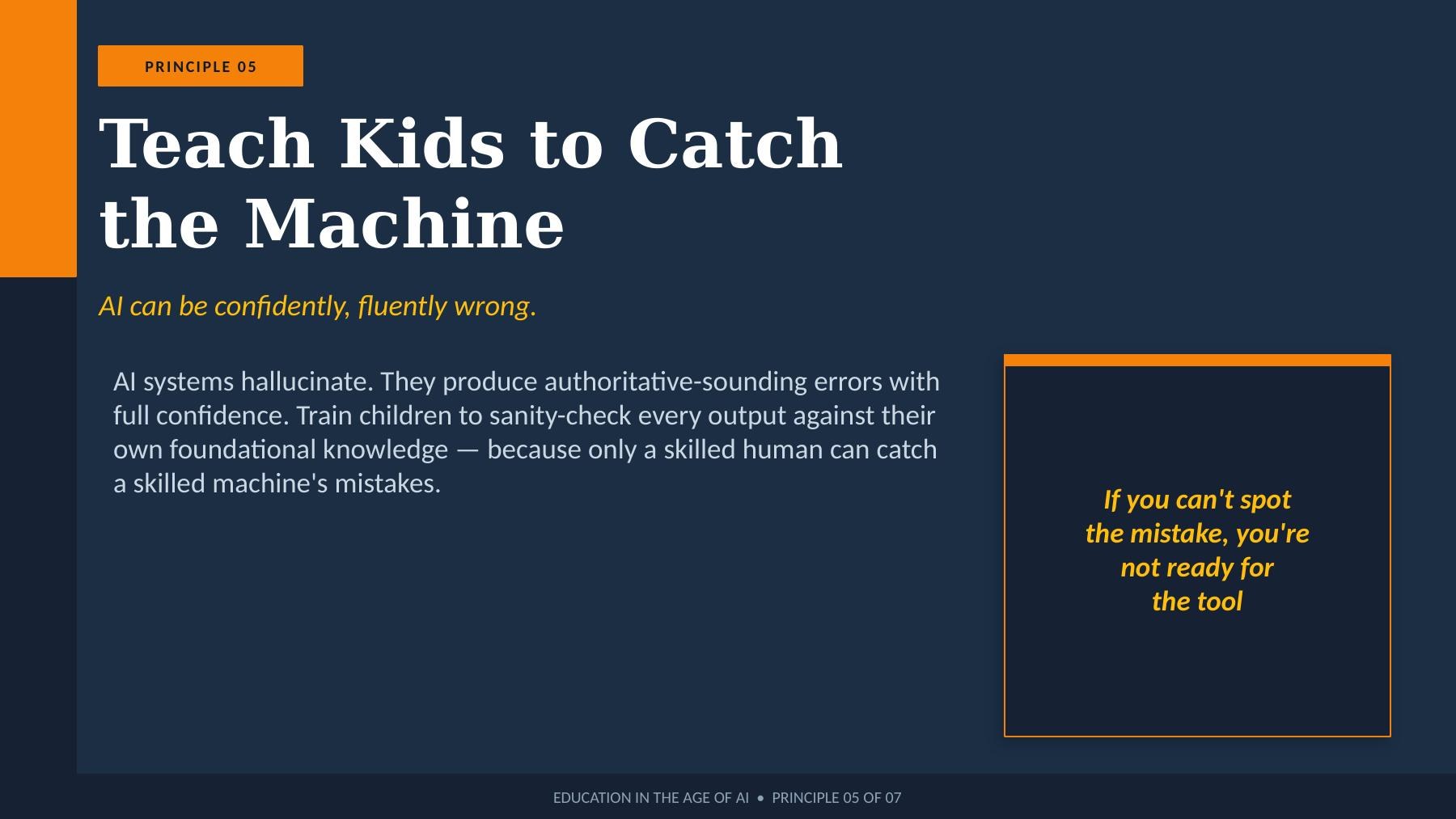
AI can be confidently, fluently wrong.
AI systems hallucinate — they produce authoritative-sounding text with full confidence, even when the content is fabricated. Children who lack foundational knowledge cannot catch AI errors in that domain. Train children to sanity-check every output against their own knowledge. If you can’t spot the mistake, you’re not ready for the tool.
Build, Don’t Browse
Creation compounds. Consumption evaporates.
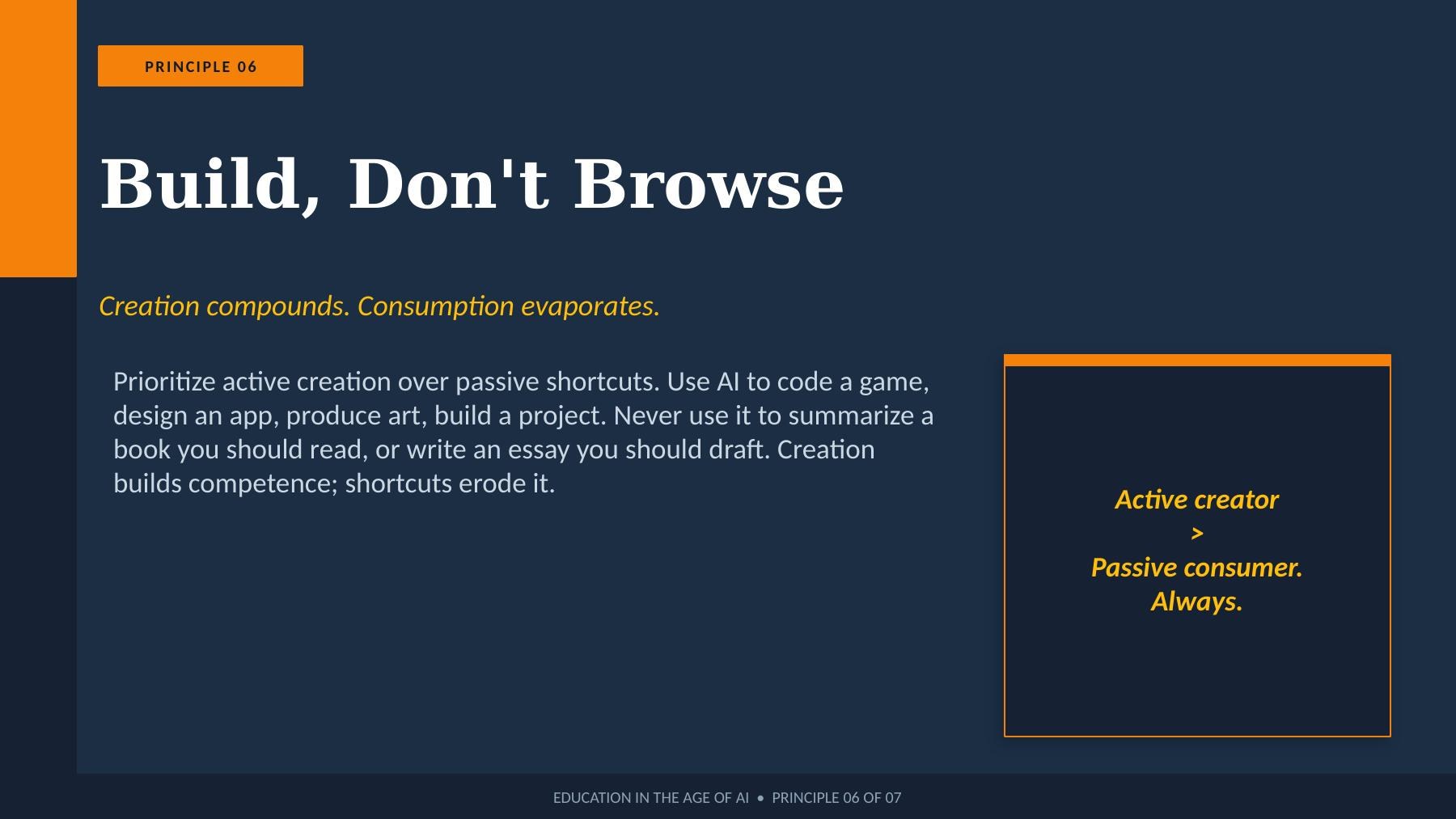
Using AI to code a game, design a project, or produce original work — that is creation. Using AI to summarize a book you should read or write an essay you should draft — that is shortcutting. Creation builds competence. Shortcuts erode it. Always ask: “Is this AI use adding to my capabilities or substituting for them?”
Attempt Before Augmenting
Your brain goes first. Always.
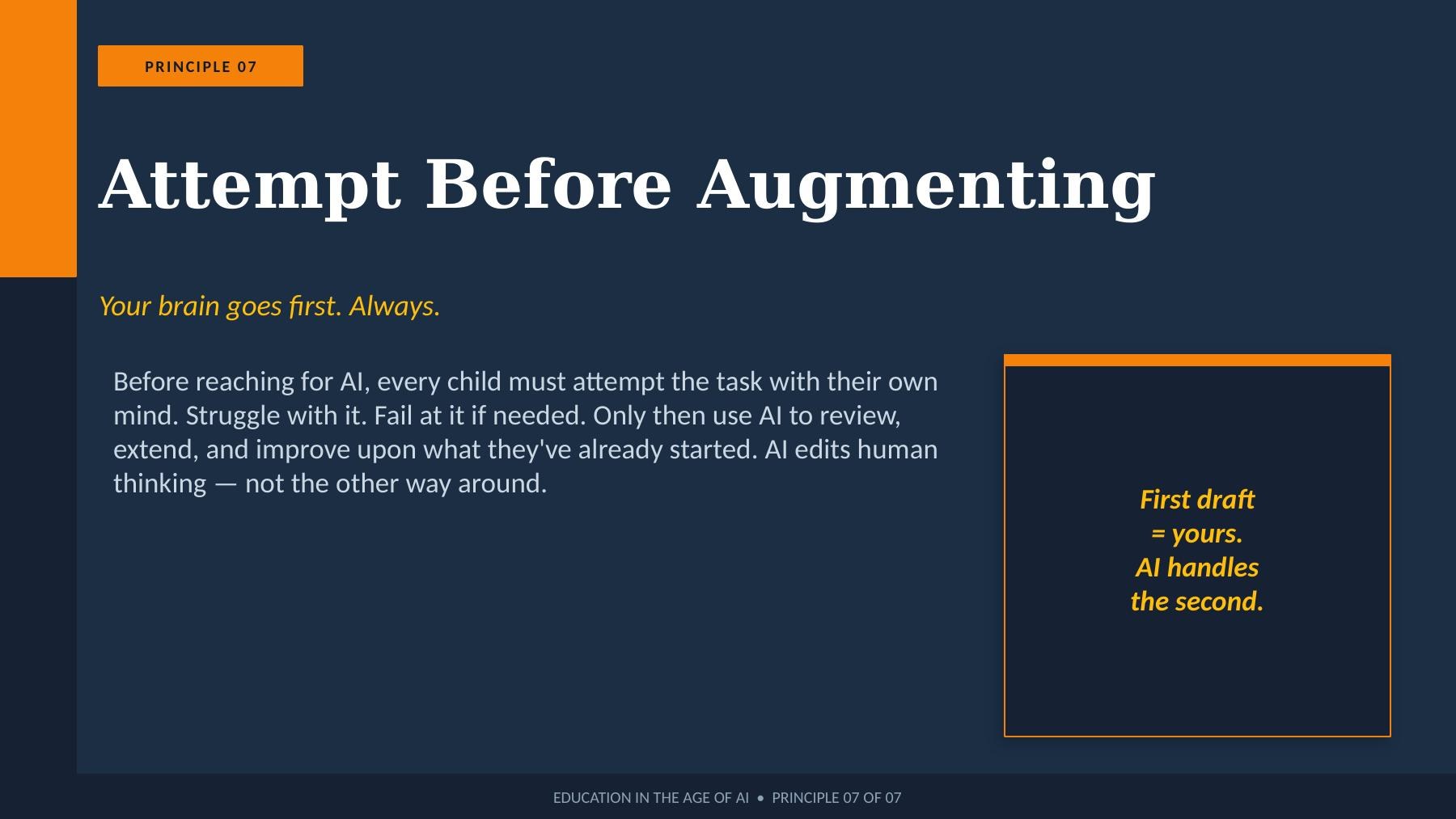
Before reaching for AI, every child must attempt the task with their own mind. Struggle with it. Fail at parts of it if needed. Only then use AI to review, extend, and improve upon what they’ve already started. AI edits human thinking. It does not replace it. First draft is yours. AI handles the second draft.
The Gift of Struggle
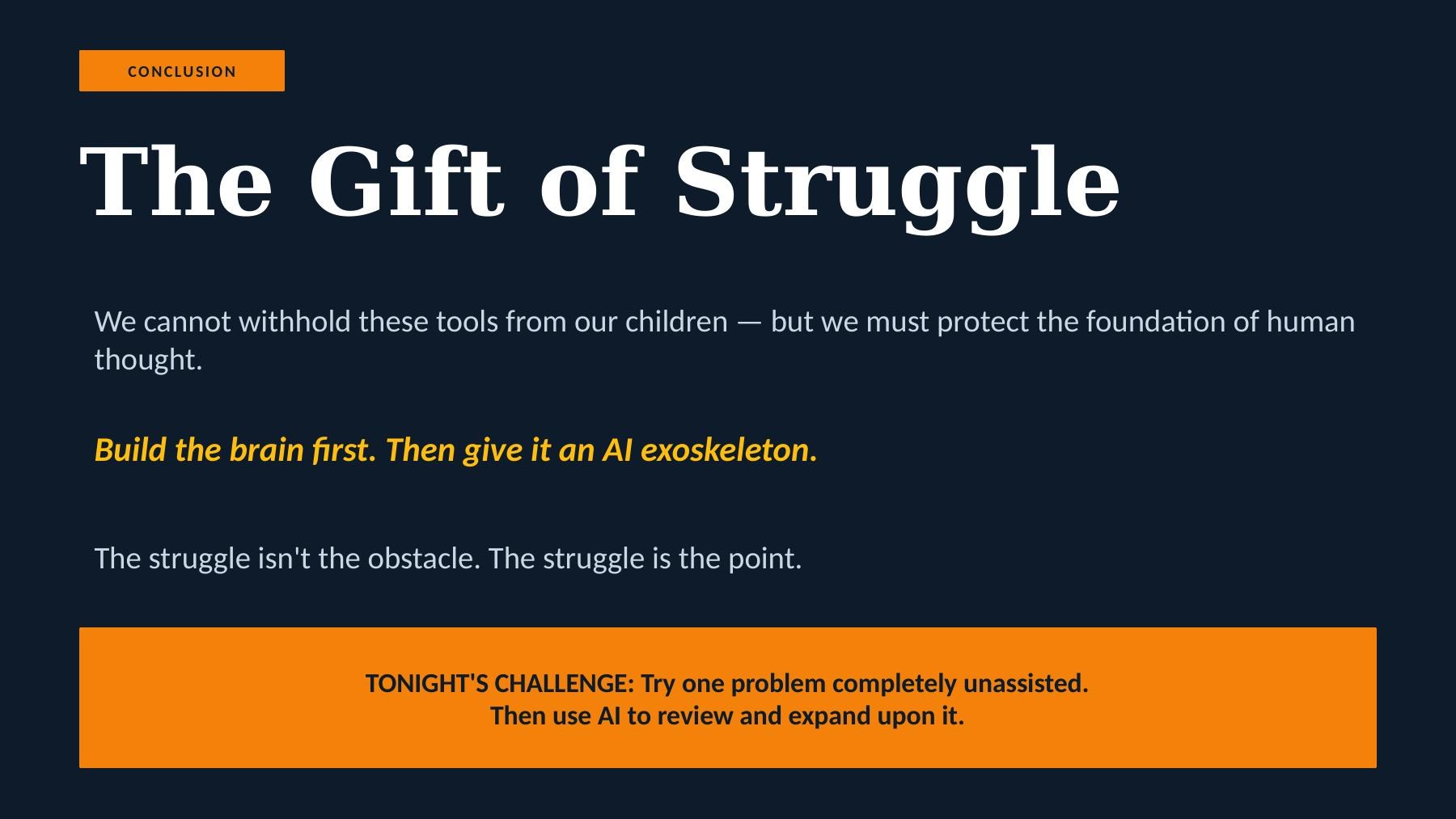
We cannot withhold these tools from our children — the world they will enter is built on them. But we can, and must, protect the foundation of human thought before we hand them the exoskeleton.
The struggle is not the obstacle to learning. The struggle is the learning. Build the brain first. Then give it an AI exoskeleton.
Frequently Asked Questions
Is AI dangerous for children’s education?
AI itself is not dangerous — but using it before building foundational skills is. The risk is cognitive offloading: when students delegate thinking to AI before learning to think themselves, the neural pathways that support complex cognition don’t develop properly. Sequencing is everything.
What age should kids start using AI tools?
The better question is: have they demonstrated foundational competence in the relevant domain? A child who can read fluently, write independently, and evaluate an argument can begin using AI as a writing assistant. One who cannot should not — regardless of age.
How do I know if my child is using AI appropriately?
Ask them to explain their work without the AI present. If they can walk you through their reasoning and catch errors in their own output, they’re directing the tool. If they can’t explain the work at all, the AI did the work.
Should schools ban AI like calculators were banned in the 1970s?
No. History shows banning calculators didn’t work. The answer to AI in schools is sequencing: foundational competence first, structured AI access second, open-ended access third.
Want the full slide deck?
Download the complete 15-slide presentation — ready to share with teachers, co-parents, or your school board.

Leave a Reply
Want to join the discussion?Feel free to contribute!